Monday, June 2, 2014

Filipino Mannerisms and Stuff

I'm going to state the obvious: Americans and Filipinos are very different from each other. It's not only the cultures and traditions that make us different though, it's the mannerisms and habits that magnify this difference. For me, it's the combination of these little things that make the biggest difference in every day life. Just to satisfy your curiosity (because I'm sure you're all sitting on the edges of your seats waiting to hear these differences like your lives depend on it), I'll tell you some of them, or at least the ones that are the first to come to mind. I'm not sure if “mannerisms and habits” necessarily describes all these things, but those are the best umbrella terms I can come up with.

First of all, Filipinos are very expressive with their faces. If they can get a message across without using words, they do it.

  • The eyebrow hello. This is the simple raising of the eyebrows (or eyebrow bob as I'll refer to it) in greeting while looking at someone in passing, very similar to “the nod” in the States, but with no bobbing of the head, and therefore, requires less effort. I've become very used to this, and it's really nice because “when I walk in the spotlight, this is what I see, e'rybody stops and is staring at me” (little musical interlude there), and if I happen to make eye contact with them, I just do the eyebrow hello, they do it in return, and it defuses the awkwardness of me catching them staring at me. You have to be careful with this though because if your greeting becomes too enthusiastic and you do two eyebrow bobs instead of one it turns from a hello greeting to a come hither, sexy kind of thing. Definitely something to be cautious of.

  • The eyebrow yes. Just like with using an eyebrow raise for a greeting, Filipinos also use one simple eyebrow bob to say “yes”. It took a while for me to actually catch on to this and for me to automatically catch this as an answer to my question. Imagine asking a Filipino a very simple yes/no question and have them just look at you in silence doing an eyebrow bob. For a while I'd think I was just getting my Cebuano words mixed up so I would try asking different ways: “Are you going to the store later?” [eyebrow bob]..... “Later, are you going to the store?” [eyebrow bob].... “To the store, going later, are you?”[eyebrow bob].... “Are you going to the...market?” [eyebrow bob].... You can imagine the frustration. Eventually I caught on and now I do the eyebrow bob myself sometimes.

  • The mouth huh. If Filipinos don't hear you or understand what you're saying, they hang their mouth open until you repeat yourself and they understand. If they still don't understand you after you've repeated it, then their mouth gap gets even bigger to intensify the degree of non-understanding so you REALLY understand that they REALLY don't understand you. So it's like saying “huh” without actually saying anything. Like with the eyebrow yes, it took a while for me to pick up on the subtle movement (although some people open their mouth as wide as possible so that it's actually not that subtle). But now it's become second nature for me to also do this, and it's kind of fun. So I'll apologize in advance for the dumbfounded-mouth-hanging-open expressions I'll undoubtedly have once I come back.

  • The lip point. Instead of pointing in the direction of something with their finger or doing a head nod in that direction (like some Americans do), Filipinos turn to the lip point. It's actually a combination of pursing their lips and pointing their chin in a certain direction (I'm gonna guess you're trying this right now as you're reading and looking like an idiot). They can respond this way to questions like “which direction is the bank?”, “where did you put the water?”, etc. It's interesting when a Filipino has to talk while doing this because then he has to talk with his lips pursed, which is just a whole other kind of funny.

For the rest of these I'm not sure what category to put these mannerisms/habits in, so we're just going to move to an uncategorized list.

  • Shhhhht!!! Filipinos make this sound whenever they're trying to get someone's attention or scare a dog or cat away, kind of like when Americans use “hey!”. If executed correctly, this “shhhhht!” can carry a really long distance. For me it's a hit or miss if I can get the sound to carry a few feet. I have to really be feeling it for it to be heard. Apparently I still haven't embraced my inner-Filipina.

  • Touching. Especially among females, Filipinos are very touchy. If two girls are walking together, chances are they are touching in some way, either linking arms, holding hands, or leaning an arm on the other. Many times if I'm walking with a woman from my office she'll grab my arm to escort me wherever we're going. Males are also touchier with each other than in the States; and by touchier, I mean they actually touch each other for more than just a high-five, a fish pump, or a quick bro hug. They'll put a hand on the others leg if they're sitting down or lean into each other, and these are straight guys. Like I said, this is a very touchy culture. Cross-gender touching only happens if people are dating and even then, it's just hand holding. But if people are the same gender, chances are they're touching, at least in the 20's and younger generation.

  • Waving. When Americans wave people over, we do it with our palm facing the sky. Filipinos do it the opposite way with their palms facing the ground, kind of hanging their hand from their wrist. It looked weird this way when I first got here, but now the American way looks weird to me and I kind of laugh to myself whenever I see the American wave on TV. I've personally adopted a combination of the two waves, where if I'm waving with my right hand, my fingers are pointing at a 7 o'clock – 7:30 direction instead of the Filipino 6 o'clock and the American 12 o'clock. So I'm basically doing it Filipino style while still keeping some American in me (maybe this little bit of American is what's hindering me from getting the correct amplification of my “shhht” sound.

  • Sleeping. This should actually be called “lack of sleeping” because I have no idea how Filipinos survive with their sleep schedules! They must be a breed of super human because the majority of them never get more than 3 hrs of sleep at a time. I've noticed this with the 2 different host families I've lived with where I've been able to observe their sleeping habits on a daily basis in order to collect data for my completely legitimate scientific study of Filipino sleeping habits (joke lang aka just kidding). But seriously, from what I've observed, the average Filipino goes to bed around 1am or 2am, wakes up between 4am and 6am, then they'll take a couple of naps throughout the day, never lasting more than an hour or two. I really don't understand how they can live their lives with this schedule.

  • The Absence of Clapping. I didn't notice this until I left Western civilization, but we are very clap-happy. After concerts, performances, speeches, anything where someone stands out of a crowd to do something, we feel compelled to clap, sometimes for 5 or 10 minutes so the performer REALLY understands how much we appreciated their act. Filipinos aren't programmed this way; they barely clap, at least compared to Americans. Or they do clap, but only halfheartedly and just for a few seconds. I don't think it's to be rude or anything (even though Americans would find it very rude to have a performance met by the bare minimum amount of clapping) it's just not part of their culture. And to offset this, many times, the DJ of the performance will play a clapping track, which is always super loud and super overdone and drowns out the clapping done by the actual audience. But now that I think of it, maybe that's why Filipinos don't clap that much, because their clapping would be drowned out anyway so what's the use in wasting the energy and making your hands go raw? Huh, never thought of that. Maybe they're on to something...

  • Music. I guess this is a good lead-in to music in general. The only music I've heard here are Filipino songs in Tagalog or Cebuano that all have a very 'Pop' music kind of feel and American Pop music. Nothing else. I'm going to be completely out of my Country music scene when I get back (sniff sniff). (I want to give a shout-out to my lovely friend Chelsea who's been trying to keep me somewhat up to date with the new songs coming out :) Anyone else is welcome to contribute and tell me good new stuff to look up on my internet days!). Anyway, back to this music stuff, Filipinos of all ages are into Pop music, old and young. And whenever music is playing, it's blaring! You can heard music playing at the gym 4 blocks away when they're having dances or concerts. My house is about 2 blocks away so I can still hear the music at 3 am even with my fan on. Then if there's a new song that's becoming popular, it's played ALL the time! When the song “Clarity” by Zedd came out a few months ago, the plaza outside my Municipal Hall played the song on repeat for a few days straight. And the song from Frozen “Let It Go” became an overnight sensation. So once songs get started here, they really take off.

  • Introductory questions. Filipinos can be very straightforward with some things, especially when it comes to introducing yourself. For example, the first time I introduce my self to someone, the questions I usually get are “What's your name?” “Where are you from?” “How old are you?” “Are you single?” in that order. Male or female, these are the questions they ask. Then when I tell them I'm only 22 they respond with “So young! Where are your parents?”. It's very difficult for them to understand that we don't live with our parents until we're at least married. But anyway, this is the dialog I have almost every single time I'm introduced to someone else. Maybe they'll ask about why I'm here and what my job is, but that's only a secondary curiosity of theirs.

  • Comments. Another thing Filipinos are very straightforward with are comments on appearance. There is one guy in my office that tells me every time he sees me that my face is looking very fat, then goes on to mimic a chipmunk cheek kind of expression. I really don't understand where he gets that because I look exactly the same as when I first got here and he just started doing this a couple months ago. There was also one day where my host family told me at breakfast that I was looking very skinny today, but then 10 minutes later in my office I was told I'm looking very fat today. Another time I had gone running in the morning, showered, then gone to work and the second I walked into the office someone asked me “What's wrong with your face?”. I guess my face was still a little red from running, but the way they asked it was just very blunt and straighforward. They don't say any of these things to be offensive, but just to make a comment and to say that they're noticing you, or to satisfy their curiosity. This is a really good culture for people who are sensitive about their weight or appearance to come to, because you learn really fast to brush it off and not take anything offensively because that's really not how they mean it.

  • Long sleeves on hot days. The final thing I'll list here is how Filipinos wear long sleeves and long pants on hot days. The hotter the weather, the more they cover up. They do this because they don't want the heat of the sun on their skin and they don't want their skin to get darker, but I honestly don't know how they can stand to be covered head to toe (even with a shirt tied over their head so they only have a slit for their eyes) on days with 90% humidity and over 100 degree temperature and not die of heat stroke while working in the fields. I don't care how used to the heat they say they are, it's just not natural.


So once again, this is all for my list of weird Filipino things. I'll start posting about work soon but if there are any other cultural things you wanna hear about let me know and I'll see what I can do! Cultural differences is always a hot conversation topic among PCVs so there's always something to say about everything!

Wednesday, May 28, 2014

Food, Food, Food!!!!

I'm gonna apologize in advance for the length of this post, but hey, it's about food. So how can I not have a million things to say about it? One thing I've learned here, food can either make or break your day, as I've experienced many times.

I have now been in the Philippines for about 11 months. During this time I have grown very accustomed to the local cuisine and don't even raise an eyebrow when told that the meal was cooked in pig's blood or contains liver bits. I have also come to crave very simple things that I took completely for granted in the States. I'm trying to decide which I should write about first because I know when I start talking about the American food I'll work myself up and then be forced to come back down to Earth again. So should I get all emotional about food now or later??? Hmmm....this is a real dilemma.......oh whatever! I'm already getting all worked up about it so I may as well just continue! (Disclaimer: I could probably write a 10 volume novel on all the food I've been craving but I won't put you through that, so I'll just go with the highlights.)

First off, you'd be surprised how many time the topic of peanut butter comes up in conversations among volunteers. One time I was having dinner with some of the other volunteers and we had a 20 minute conversation about peanut butter, no joke. We talked about the best brand, creamy vs. crunchy, the best way to eat it, what we would give to have some peanut butter right now...you get the picture. I mean, I liked peanut butter in the States as much as the next PB&J fan, but it's a down-right obsession here. A single jar of peanut butter is sacred to the average volunteer (I say average because there are some crazy volunteers that don't even like peanut butter...go figure). My parents sent me a box with 10 jars of peanut butter (there may have been more, I forget) and in the States that could probably last me almost a year, or at least 6 months. But after 3 months, I'm on my 2nd to last jar. That stuff's addicting! Especially when it's the only munchy available when watching tv shows.

Next, sandwiches!!!! It's pretty much impossible to find good sandwich bread, cheese, and cold cuts in this country, believe it or not. You never realize how much of a staple in the American diet sandwiches are until you have to go without them for what seems like a lifetime. And those three ingredients (bread, cheese, and cold cuts) go into way more meals than you would imagine (okay, maybe not the cold cuts too much, but definitely the bread and cheese). So you're just forced to go without those, which can just kill a girl.

I've been able to find decent substitutes for American pizzas and burgers here, but let's just say it'll feel so nice to be able to sink my teeth into the real deal. One of the most painful experiences here food-wise occurred a couple of months after coming to site. I was with the other volunteers in the area and we decided to splurge on a pizza while watching a fiesta's parade. We ordered our veggie pizza, completely stoked for what was in store for our ravenous stomachs. We opened the pizza box and were a little puzzled by the appearance of the pizza. The crust looked like a dense pita bread, there were carrots on top, the cheese was a weird color, the sauce didn't quite look right, and they'd given us tubes of banana ketchup as a condiment. We all had our reservations, but we're Peace Corps volunteers, gosh-darn-it! If we order a pizza, we're going to eat it and enjoy it!! So we all grabbed a piece and began to eat. Now, it's been a few months since this happened so I can't remember the exact taste, but I'll just say that not one of us (the guys included) finished a second piece. We counted our loses, gave the remainder of the pizza to some street kids, and to this day cringe when we talk of that pizza.

Back to the happy side of food! Salads!!! I always took those for granted in the States, but it is surprisingly hard to find any kind of salad here and decent dressing to go with it. The concept seems strangely foreign to Filipinos living in such a tropical environment, surrounded by greens. I had my aunt and uncle send me some good ol' ranch dressing though, and I've managed to make it last quite a while, eating it with cucumbers and carrots (and Filipinos would consider that a salad, just two veggies). The first time I did this my host family gave me quite a few stares, but I've trained them to accept my sometime weird food habits, even if they can't understand them.

Breakfast foods!! To Filipinos, breakfast includes the same kind of foods as lunch and dinner. They eat the left over fish and rice from the night before for breakfast. I quickly taught my family that I could not do this. I will succumb to many of their different cultural tendencies, but that is one that I will insist on holding strong to my American upbringing. One breakfast food I hadn't realized I missed so much was granola. I'd never been a huge granola eater in the States, enjoying it every now and then but never going out of my way to get my hands on it. Well I asked a volunteer who was visiting the States to bring me back a box of it. It was vanilla almond flavored. Up to this point I had been eating corn flakes cereal for breakfast every day – a Filipino brand of cereal that really has no flavor or sweetness (and I usually go for the sugary cereal or add a cup of sugar to each bowl) – and had gotten used to the non-flavor of it. When I got my first bowl of granola, I wasn't expecting anything ground breaking, just a nice break from the monotonous corn flakes. The second the granola touched my tongue, however, my taste buds went crazy! I had tingles all over my body and I felt like I had just entered another dimension in the world of food!! I'd never had such a strong reaction to food. Even now as I'm typing my mouth is watering just remember it. I was very proud that I made the box of granola last a week. And then the other breakfast foods we find so common (eggs, pancakes, toast, french toast, waffles, etc) are almost unheard of here except in the cities or within the homes of the more westernized families. Filipinos have lots of eggs, but they only do hard boiled eggs. So many opportunities with eggs that they simply don't take advantage of, it breaks my heart.

So like I said earlier, I could go on for pages and pages about food I miss, but I'll make myself stop here and go on to Filipino food stuff.

Fish. I mentioned fish in a previous blog, but I'll reiterate here: they prepare fish differently. They don't clean the meat off the fish, then cook it, then serve it. They gut the fish, cook it, then serve it, with the head, eyes, fins, tails, and bones all there. If there is fish on the table, it's assumed that you'll eat with your hands (at least with my fish eating ability it is; some Filipinos eat the fish with fork and spoon, using it to get the meat off the bone, but I haven't mastered that technique yet, and frankly, it takes the fun out of it). For me, I put the fish on my plate with some rice and a side plate of soy sauce. I pull the meat off the fish with my hands, remove the bones I find, dip the meat into the soy sauce, then mix the fish with rice, using the soy sauce to help hold the rice together, and then enjoy! I actually really like eating fish here. It's an excuse to play with my food. There are other ways to prepare the fish also. One of the most common ways (apart from frying the fish) is drying the fish. To do this, you cut the fish in half along the dorsal fin, open it up “hot dog style” (as we'd say in preschool), and leave it in the sun for a few hours until it's all dried up. I think they pour salt on it too to help with the drying process. I generally don't eat the fish this way because it's really really salty, and I prefer the fried method.


Mango Float!!!!!!!! Sadly I haven't had this too often here, but it's by far my favorite food that I've eaten. I guess it's more of a dessert, but I eat enough of it to make it a meal when I get the chance. It's a layered dessert with layers of graham crackers (pronounced grA-ham here), sweet and condensed milk and cream mixed together, and slices of mango. Put it in the fridge or freezer for a few hours and enjoy!! I swear it is one of the best things I've ever tasted in my life. When I was having a particularly rough week two of my volunteer lifeline friends made it for me and it instantly improved my mood! It's the best way to be cheered up!!


Buko Salad. This is another dessert. Buko is the Filipino word for coconut. It's a chilled dessert with coconut meat, coconut juice, sweet and condensed milk, and these random fruit flavored chunks. It's really good, although I have no idea what the chunks are actually made of.


Halo-halo. This is a traditional Filipino dessert. There's really no way to describe it since they can contain different things depending on who makes it (and probably the region of the Philippines you're in). Halo in Tagalog means mix, so the literal translation of the name is “mix-mix”. It's really just a random mixture of different things. It's also chilled so it has crushed ice, sweet and condensed milk, sometimes ice cream, the random fruit flavored chunks also found in buko salad, sometimes corn flakes, sometimes beans, sometimes corn, sometimes chunks of sugar, and sometimes other stuff. It's really weird, but when you find a good mixture, it's really good. You'll just have to come here and try one for yourself!
This is just one version of the dessert but it shows the colors and some of the variety of the ingredients.

Pansit. This is a noodle dish that's a go-to for Filipinos. It's made with rice noodles and has chunks of meat and some vegetables thrown in. Like the halo-halo, this too can vary depending on who makes it.


Lechon. Aka roast pig. They cook it over a fire pit with a piece of bamboo going through it, mouth to butt. They roast it over fire and coals for a few hours until it turns tan and the skin is nice and crispy. Every major Filipino event has lechon. If lechon was eaten by Americans on a regular basis, we wouldn't do it justice because we'd only eat the meat and throw everything else out. But here they eat EVERYTHING: the meat, the entrails, the blood, the hooves, the fat, the ears, and the skin. The skin is by far my favorite part, even more than the meat. It gets nice a crispy with a thin layer of fat underneath with salty seasoning....'tis perfecto!! (cue terrible Italian accent and kissing of finger tips).


Spaghetti. Pretty similar to the States although they make is sweet here. I don't know how they do it but they do. I prefer American spaghetti.

Adobo. The name for a certain kind of preparation involving cooking the meat or vegetables in soy sauce, vinegar, onions, and garlic. It's delicious and you can cook pretty much any meat or vegetables adobo-style (that I've noticed).

Rice. Of course I had to mention rice. Within the first 2 months here I ate more rice than I'd had in my entire life! Crazy! It's eaten for breakfast, lunch, and dinner. No meal is complete without it. Even after being here for almost a year with my host family getting to know me and my eating habits, if there is a day I choose not to eat rice with a meal they give me the strangest looks ever! The proportion of rice to meat (or whatever else they're eating) doesn't make sense to me either. They'll have a plate towering with rice and one 5 inch long fish to go with it. It puzzles me. And Filipinos are so creative with the different ways to prepare rice, too. It can be made into a patty-like-consistency and made into a sweet dessert, or made watery with chocolate and turned into a kind of soup, or so many other ways. Simply put, Filipinos would die without their rice.

Fat. When I say this I don't mean they'll eat the small pieces of fat attached to meat unlike most Americans who cut around the fat (I'm guilty of this). I mean they eat chunks of fat...only fat....no meat. I was completely baffled when my host family during training told me about this and they were in turn completely baffled when I told them I don't eat fat. It was one of the instances where you just stare at each other and cannot, for the life of you, fathom why the other culture does something. My host family had a nice time teasing me about it the rest of the time I was there though.

Banana Leaves. This doesn't have to do with eating as much as food resourcefulness. Banana leaves are used for everything here. They're used to cover the food and protect it from flies, as table clothes/covers, and “paper” plates. The leaves are huge so their purpose is pretty versatile. I was told this was an interesting fact so decided to share.

Okay, I think I've gone on for long enough about food. So I'm gonna end this here. I'm planning on writing a post soon about what's going on a work, so...Coming Soon to a Blog Near You!!

Tuesday, May 6, 2014

The Ultimate Volunteer Story: Kids Edition

I know it's been a while since my last post, but there really hasn't been much going on. However, I started a new routine a couple weeks ago that has rendered a good story. I'm registered to run a 10k this Sunday (which I realize now is Mother's Day so Happy Mother's Day!!). I've never run a 10k distance in my life, so my goal is to simply do the whole thing without walking. We'll see how it goes. Anyway, the last few weeks I've been training and got in the routine of running after work at the Oval (aka track). I'll set the scene: the track is packed dirt with a few rocks here and there and in the middle is a basketball court, volleyball court, a small soccer field, and a tennis court (basketball and tennis court at either end of the track with volleyball and soccer in between). I'm actually very lucky to have this area – not many volunteers have a site with a track.

So most days after work I've been playing volleyball until dark (which is at 6-7 pm year-round) and then I run. I've been doing this routine for just a few weeks now and already everyone in the Oval knows my name (not because they necessarily know me but because I'm the strange foreigner and one of the few girls doing something athletic, so why wouldn't they be curious as to what my name is?). When I enter the Oval many people shout out greetings and it feels nice and welcoming. There's also a group of about 10-15 kids (maybe ranging from 8-12 years old) who hang out around the tennis court shagging balls for the players. My story centers around these kids.

The first few times I ran, the kids would just stare at me every time I went past the tennis court. After a while they started shouting my name and waving at every passing, and it continued this way for about a week. Then one evening they started getting more enthusiastic with their waves and would even run to the track for a close up view of me running past (after being in this country for 10 months I'm very use to this fishbowl-everyone-staring-all-the-time stuff). A couple laps later they actually began spreading across the path and holding hands, forcing me to charge them and break through their barrier with them laughing and squealing at my snarling growl (and I tell you, after a few laps of this it got exhausting having to muster up the energy to do this every lap, but how can you refuse those hopeful looks and squeals of laughter). Then one lap, instead of forming a line across, they were all congregated in a blob right in the middle. As I neared they opened a small opening for me to go through and as I got in the middle of them they started running with me! I was swallowed up by 15 kids running around the track! It actually felt to me like having a swarm of gnats surrounding me, in a good way of course (if that's possible). The little ones didn't even make it half way around the track though; they decided to stop a quarter of the way, cut through the middle, and wait for me on the other end to finish the lap with me. The older ones made it the whole way and some of them even tried to race me (although this was towards the end of my run so I had very little steam left).

So for the last few laps of my run the older kids (the younger ones were tired after that first lap) would run with me for one lap, then rest, then run, then rest, and it was a nice little pattern. I did my last lap with the older kids, finishing on the opposite side of the tennis court. We walked my cool down lap and picked up the younger kids as we walked past the tennis court and headed over to the stands where I do my stretching and crunches after every run. I figured the kids would go back to the tennis court once they realized I was pretty much done with the exciting stuff, but nope! They stuck with me and counted to twenty while we did stretches, crunches, push ups, jumping jacks, more stretches, and anything else I could think of to entertain them. At one point we were even copying the moves of a Filipino exercising on the other side of the stands (not sure if he realized a foreigner and a bunch of kids were copying him, but it worked out okay).


Since that day there are still a few kids who have joined me for my running and stretching, and one kid in particular who seems particularly devoted. It's quite cute, really. But I think this is one of the experiences I'll take with me and think back on during the hard days because everything is so much more fun and enjoyable where there's a laughing kid there with you!!

Friday, February 14, 2014

Prom Filipino-style

So I admit, I've let this whole blogging thing slide a little, and I wish I could say I'll get better, but to be honest, it probably won't happen. There haven't been many new developments to report, just the ongoing battle to find my place in the LGU, find projects to work on, figure out my life outside of work, learn the language, and continue adjusting to this completely different culture.

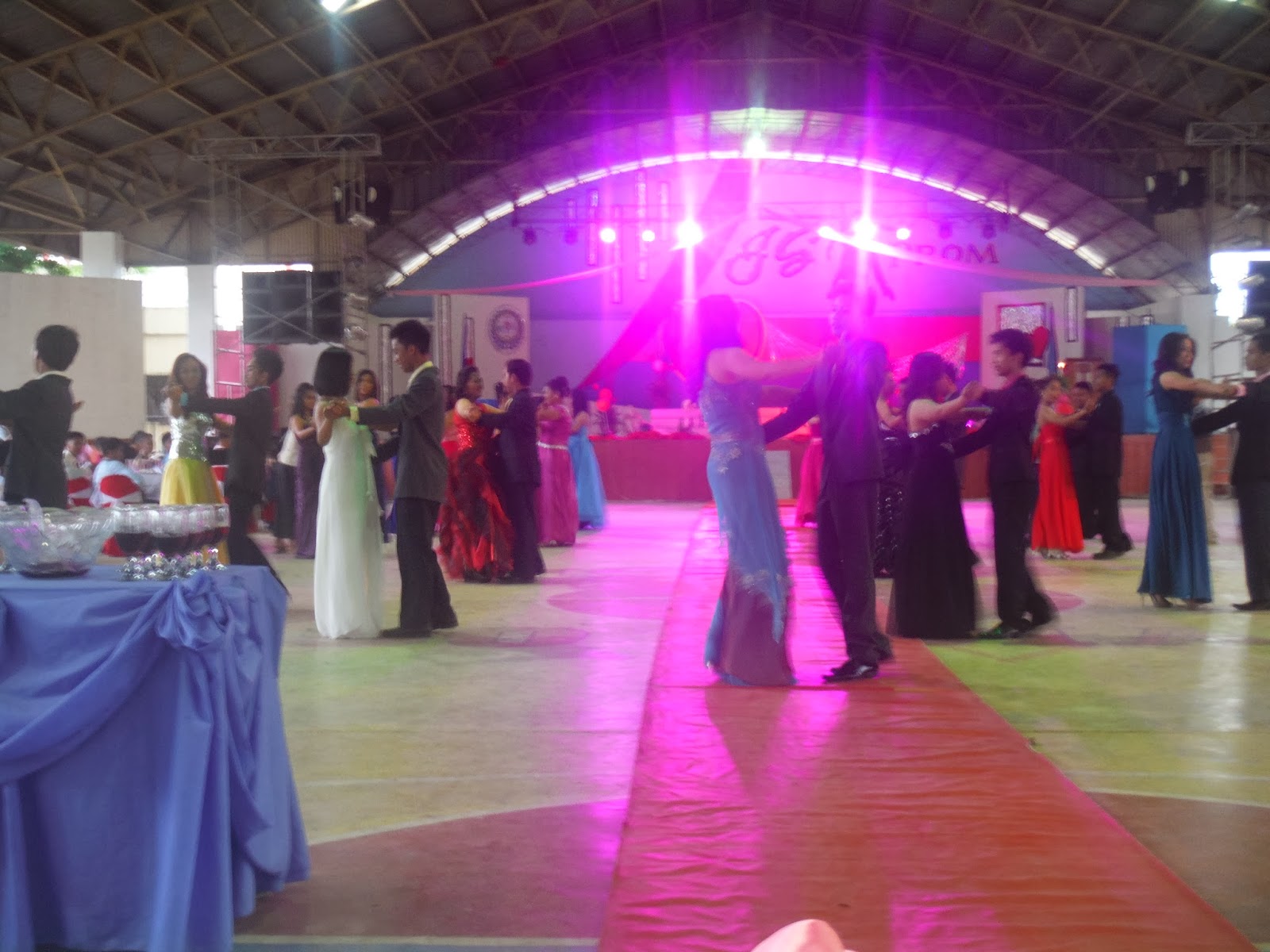
One thing I deemed worthy of a blog post, though, was the Siaton Science High School prom I just attended. And when I say “just attended,” I mean “just attended,” as in 20 minutes ago I was there and now I'm writing about it so I don't forget any bizarre details. My host family aunt here in Siaton is the principle of the high school so I got to experience the event from the observing teacher's perspective. I'll start with the logistics:

WHAT: Siaton Science High School Junior and Senior Prom

WHO: Juniors and seniors in attendance of course (maybe 30-40 in each grade), teachers and parents, freshmen and sophomore students observing, and any random passers-by who happen to walk past the venue and feel like stopping to watch (it's a very public event)

WHEN: Thursday, February 13, 2pm-6pm approximately and continuing into the night

WHERE: The gym/dance/pageant/event hall located in the center of town with open walls and a stage (very nicely decorated, though)

ATTIRE: Juniors and seniors in expected prom attire with boys wearing suits and girls wearing prom-style (and also some homecoming-style) dresses and too-tall high heeled shoes (like only the kind it's possible for super models to walk in). Teachers also in prom attire, if not just fancy Sunday-best. Parents mostly in fancy Sunday-best but some just in nice t-shirts and jeans. Freshmen and sophomore students in their school uniforms. Passers-by in regular street clothes just like any other day (because to them, it is any other day). Me in jeans and a black polo with my draw-string bag (I came straight from work and had no idea what to expect. I mostly stayed in the back though so it wasn't too embarrassing.)

SIMILARITES TO AMERICAN PROM: Fancy outfits, a catered meal, dancing to the latest hits, prom king and queen (called Mr. and Mrs. Science High here), guys not asking the girls to dance when prompted, announcing couples on stage (not sure if every prom does this last one, but my prom did)

DIFFERENCES: Prom is a graded event (!!!), ballroom dancing, parents in attendance, speeches, a program

Now I'll go into the story:

To get you in the right mindset, you have to understand this is more of a ceremony than the “fun dance” American proms are like. It has the fun dance part too, but you have to get through the ceremony first. Since the majority of the prom happened in the afternoon and I had work, I wasn't able to see the entire event, but there was a program so I was able to see what I had missed. The program included speeches of thanks and recognition, the history of the school, the students saying their dream jobs (some were Apples engineers and others were fashion designers or political ambassadors), and choreographed ballroom dances. The dancing was what really caught my attention. First off, they were ABLE to do ballroom dancing, nothing too extreme mind you, but still, in the States that's not a very common thing to see high schoolers doing. The juniors have dances they do and then the seniors have a ~15 minute waltz they do. I thought that was crazy enough until my aunt told me they were being graded on the dancing and had choreographed the whole thing themselves in 2 weeks! And since there were more girls than guys (like in almost every setting in life), some of the dance couples were girl-girl. It was interesting watching couples of girls doing these dances in high heeled shoes neither of them could really walk in. There was also the handing down of the “key” and “book of knowledge” from the senior class to the junior class. Not really sure what the significance was with those, but it seemed important.

Only after the 3 and a half hour program was over did the dinner start, followed by what I like to call the fun part. And you could definitely tell when that started. I began recognizing prom stereotypes: cameras coming out and everyone taking a million pictures, guys and girls no longer dancing one-on-one but rather in groups, music blaring and making your chest pound, and girls showing the obvious pain their feet were in because of their shoes. Up until this point I hadn't been sure if the two cultures' proms had anything in common, but this eased my conscience. However, another curve ball in this event was that this “fun part” only lasted about 30 minutes. Then there was a break so everyone could go home and change into more comfortable clothes only to return later and continue the fun. I actually really like that idea, if only for the sake of high-heeled-tortured-feet. I think the States should adopt this part.

But ya, this sums up the Filipino Prom! So, until next time!


And quick update on my volunteer life, this weekend I'm leaving for my batch's 2 week long IST (In Service Training). This is the first time in 5 months I will have been able to see most of my batch so I'm really excited. We've been at site for 5 months now and in the Philippines for 7 and a half months. The time is going by so fast but there is still so much time left, which is definitely needed. I've barely begun to scratch the surface on what I can do for my community.

The decked out gym


Fancy tables and setting

Ballroom dancing

Seniors' waltz